All hotpot › What goes in
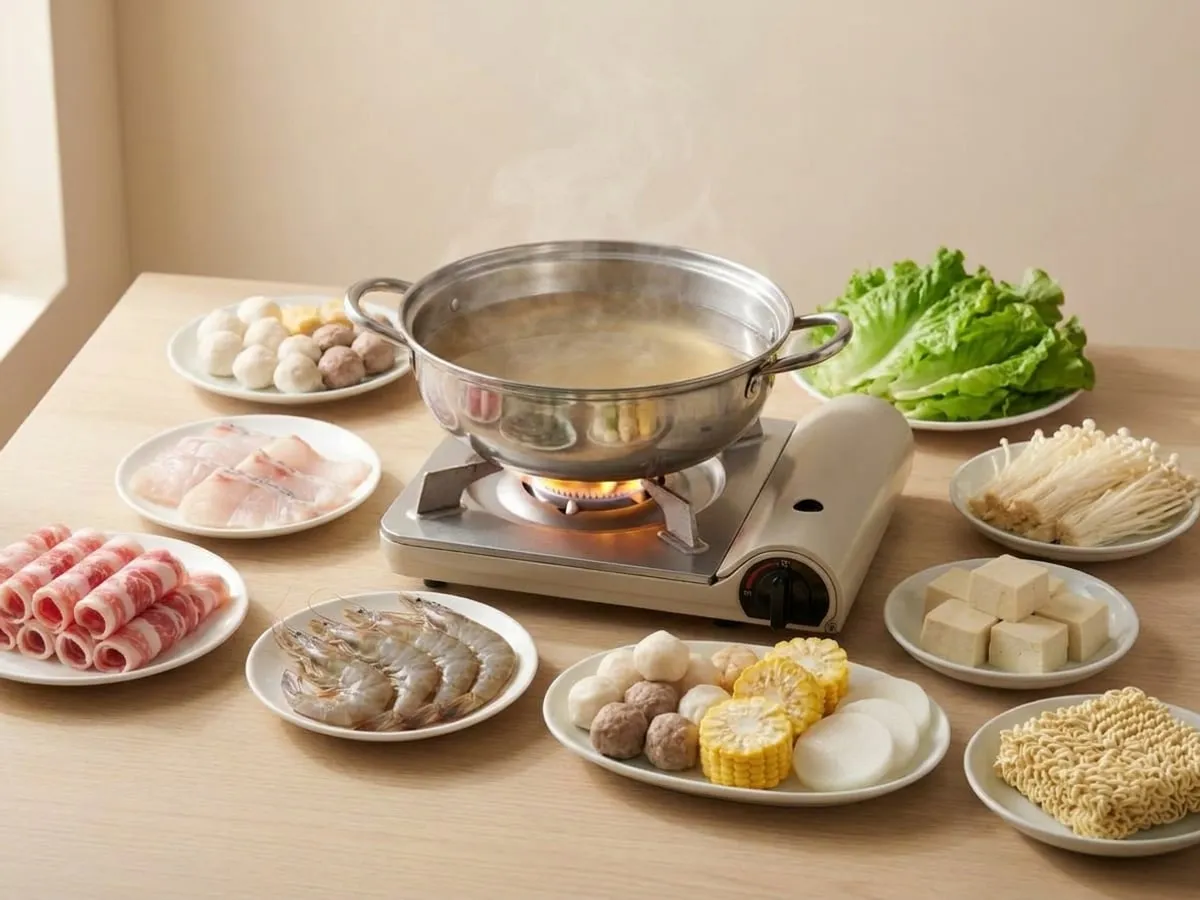
What goes in, and when
落乜嘢落鍋
“Beef wants only a quick dip. Leave it in and it turns tough.”
Equipment
- Indoors, an induction plate or an electric hotpot is the safe choice; for a gas stove, see the safety notes below
- Two sets of chopsticks, ideally in two colours; the raw pair only puts raw food into the pot
- A ladle and a slotted spoon for each side of the pot; children fish things out with the slotted spoon
- A kettle of boiling water or a pot of hot stock by the table for topping up
How it goes
- The rule over everything: the broth must be at a rolling boil before food goes in, and every time you add water, stock or a batch of frozen meat, wait for the full boil to come back before taking food out to eat. Put in a little at a time; too much and the pot stops boiling and nothing cooks through. Judge doneness by colour, by floating, by opening and by the absence of pink, with the minimum times below for liver, seafood and enoki; when in doubt give it longer.
- In first, the things that need five minutes or more: chicken pieces, corn, daikon, taro, shiitake and other mushrooms, tofu. They flavour the broth and need the time to cook through. Enoki boils at least two minutes; never eat it raw or just dipped. Chicken needs at least five minutes; cut a piece open and eat it only when there is no pink and the juices run clear. Daikon and taro need fifteen minutes or more, until a chopstick goes in easily; taro breaks up, so it can be steamed first.
- Clams and other shellfish go in at the start too: boil them until they open and then three to five minutes more, and throw away any that stay shut rather than prising them open.
- Float, then a minute more: prawn paste, cuttlefish paste, fish balls, beef balls, fish-skin dumplings, dumplings and wontons. Spoon the pastes into the pot in small balls, wait until they float, then give them another minute; prawn paste is done when it is pink and opaque. Frozen balls need a minute or two longer, and dumplings, whose pork filling is raw, need one to two minutes after they float.
- Seafood and tripe: fish slices are done when white and opaque right through, and freshwater fish must always be fully cooked. Prawns are done when the shell is red and the flesh white and opaque; a prawn that has only just turned red is not ready. Hong Kong's Centre for Food Safety advises at least five minutes at a full boil for seafood in a hotpot; for children, older people and anyone pregnant, give it the full five. Beef tripe is sold cleaned and already cooked, so heat it through in the boiling broth and lift it out; too long and it turns rubbery.
- Pig's liver: sliced thin, at least three to five minutes at a full boil, until grey-brown right through, with no pink and no blood.
- A few seconds: shaved beef, thin-sliced pork and fried bean curd rolls. Shaved beef goes in a slice at a time, swished in the broth with chopsticks and eaten as soon as it changes colour, about ten seconds; leave it longer and it toughens. Pork, however thin, must be cooked through: white all over with no pink. The fried bean curd rolls get about three seconds, and are best half crisp, half soft.
- Last: leafy greens like lettuce, pea shoots and crown daisy, ten to twenty seconds, out as soon as they wilt; choy sum goes in stems first and leaves after, about a minute. Greens can fill the gaps at any time. The broth is richest at the end: finish with udon or instant noodles, two or three minutes.
- Raw and cooked apart: raw meat and seafood go in with the raw chopsticks and you eat with your own; chopsticks that have held raw meat never go into your mouth or touch a saucer. Raw plates stay in the fridge until the pot goes on and sit on the table for no more than two hours; if the meal is slow, bring them out in batches.
- Thawing, and the children: shaved beef and frozen balls are made to go into the pot frozen, but chicken pieces, whole prawns and thick pieces of fish are thawed overnight in the fridge, never at room temperature. Liver, tripe and shellfish for children, older people, pregnant women and anyone with chronic liver disease are cooked the longest, or left out. A boiling pot at a child's height needs someone watching it, and children use the slotted spoon rather than reaching into the pot.
- At the end: if you want to keep the broth, put it into small covered containers and into the fridge within two hours, keep it no more than three days, and reheat it only once, to a full boil; otherwise throw it away. It does not sit on the stove overnight for tomorrow's congee. Fatty broth does not go down the sink.
Safe at the table
- Indoors, an induction plate or an electric hotpot is the safe choice. Australia’s gas safety regulators say butane cartridge stoves are for outdoor use only, because of the risk of carbon monoxide. If you do use one indoors, as Hong Kong homes do, keep it well ventilated, and never in a small or closed-up room.
- With a portable gas stove, never use a pot wider than the pot stand, about 20 cm at most unless the maker’s instructions allow more, and never one that reaches over the canister compartment. Never put two stoves side by side, and never leave one burning.
- Fit and remove the canister away from any flame or heat, with its notch facing up. Check for leaks with soapy water first, and do not use a stove that leaks or is damaged. Never put the stove on another cooker (an induction plate especially) or on anything hot, and put nothing between stove and pot that the maker did not supply: no foil, no extra stand.
- Buy a stove certified for Australia, set it on a level surface that will not burn, never on glass, and do not run it longer than the maker’s instructions allow. Keep sprays, lighters and paper well away. When you finish, turn it off, take the canister out and store it somewhere cool, dry and ventilated, never in a car or in the sun.
- Keep raw and cooked apart: use a separate pair of chopsticks or a slotted spoon for raw meat and seafood, and never eat from them.
- After topping the pot up, wait for it to come back to a full boil before anything goes in.
- Chicken, pork, liver and seafood must be cooked through before eating. Sliced pig’s liver needs at least three to five minutes at a full boil; Hong Kong’s Centre for Food Safety advises at least five minutes for seafood; clams boil until they open and then three to five minutes more, and any that stay shut are thrown away. Enoki boils at least two minutes and is never eaten raw.
- For pregnant women, children under five, older people and anyone with a weakened immune system: beef until no pink remains, and seafood for the full five minutes.
- Raw meat plates stay out no longer than two hours. Leftovers go into the fridge within two hours, keep no more than three days, and are reheated only once, until boiling hot.
Take care
- Nearly every common allergen goes into the pot: fish, prawn and crab (crustaceans), clams and oysters (molluscs), egg (egg dumplings, prawn paste), soy (tofu, bean curd rolls) and wheat (noodles, dumpling wrappers). Anyone with an allergy should say so before the pot goes on; in a divided pot one side can stay free of seafood.
- Chicken, pork, pig's liver and seafood must be cooked right through; throw away clams that stay shut; keep raw and eating chopsticks apart; raw plates out on the table for no more than two hours; after every top-up, wait for the full boil again. Cook liver, tripe and molluscs longest for children and older people, or leave them out.
The story
Nobody writes a recipe for hotpot, but every Hong Kong person knows the order: chicken and daikon in first, ten seconds for the beef, lettuce last, instant noodles to finish. This page is for the next generation growing up in Australia, so they need not ask Ah Ma every time.
Same kind
Lo Fo Tong is cultural food-heritage reference, not medical advice. If you are pregnant, unwell or on medication, talk to your doctor or registered practitioner before changing what is in the pot.