All Sunday dishes › The Sunday dishes
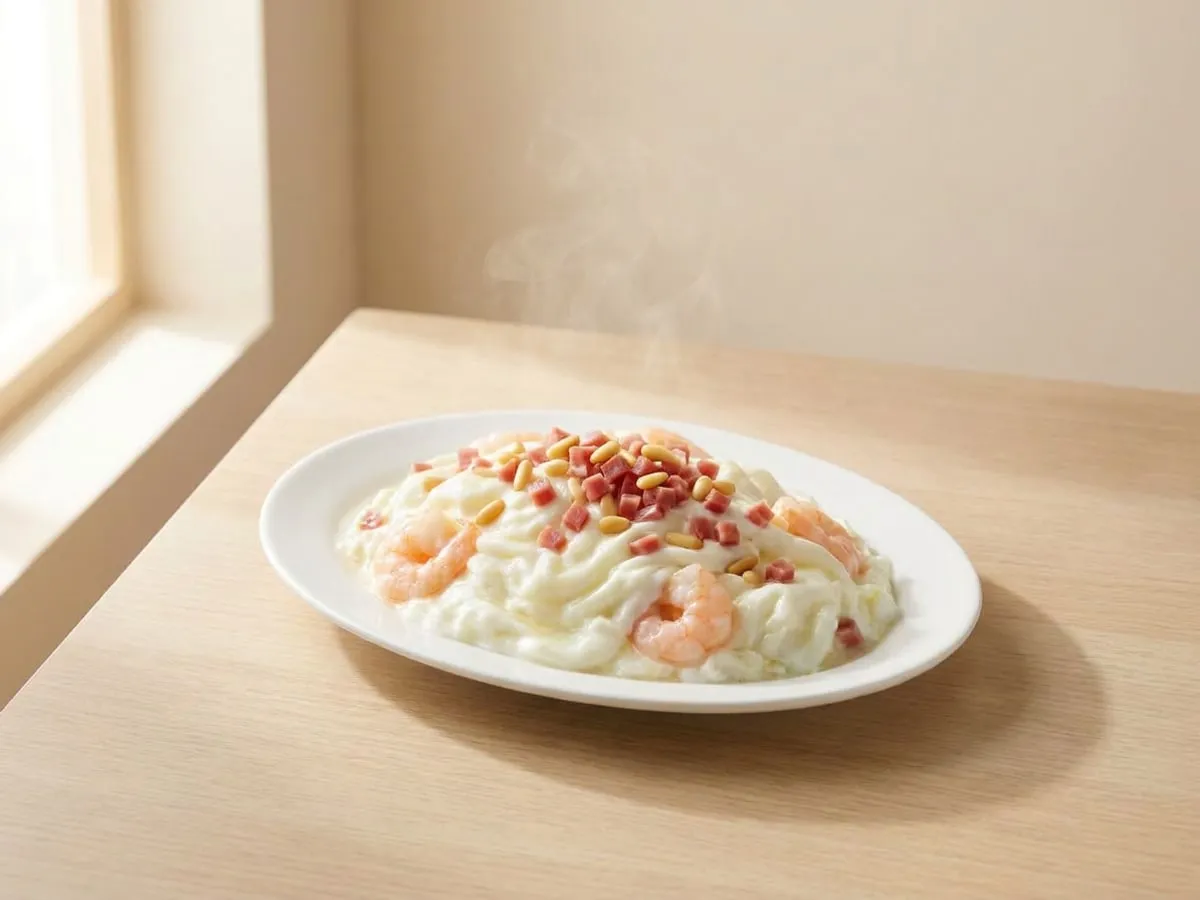
Daai Leung stir-fried milk
“This one cannot be hurried. Only start it if the day is yours.”
Ingredientsserves 4
Equipment
- A wok, or a non-stick pan, which heats evenly on a low flame.
- A wide spatula or a heat-proof rubber scraper, which pushes the curds without tearing them.
- A fine sieve, to strain the bubbles out of the milk.
- A warmed plate.
How the time splits
- 15 minSalt the prawns, beat the whites, mix the milkhands on
- 30 minThe prawns rest in the fridgehands off
- 5 minRinse, blanch and cool the prawnshands on
- 5 minAt the wok, pushing the curds: not a moment awayhands on
Method
- Rub the prawns with a teaspoon of salt and leave them in the fridge for about 30 minutes, then rinse them and dry them thoroughly on kitchen paper. Blanch them in boiling water only until they just turn opaque, lift them out and let them cool. Cooked crab meat needs only picking over for shell. Toast the pine nuts in a dry pan over low heat until golden and set them aside.
- For the noodle bed, heat the two cups of oil and drop in the rice vermicelli: it puffs at once. Lift it out, drain it and spread it on the plate. Pour off the oil, leaving three tablespoons in the wok.
- Beat the egg whites only until loose and foamy, not to peaks. Mix the cornflour with a little of the milk, then add the rest of the milk, the whites, half a teaspoon of salt and the pepper, and strain it through a fine sieve to lose the bubbles. Stir in the cooled prawns. Keep the milk and whites roughly equal: more white makes it firm, more milk makes it watery.
- Heat the wok, add the three tablespoons of oil and heat until a wooden chopstick stood in it fizzes. Swirl the oil round the wok, then turn the heat right down or off and wait half a minute. The oil should be warm, never smoking.
- Stir the milk mixture once more, because the starch sinks, and pour it in.
- When the bottom has set to a thin white skin, push it gently to one side and tilt the wok so the liquid runs onto bare metal. Repeat until nearly all of it has become soft curds. Do not stir it round: stirring breaks the curds and lets out water. Too much heat makes the milk catch and yellow and the curds go rubbery.
- Take it off while it is still glossy and a little unset, because the last of it sets on the plate; but no clear, runny egg white should be left. After a minute, tip off any water that gathers at the edge of the plate.
- Scatter over the ham and pine nuts and serve at once. It will not wait: it weeps as it stands.
Take care
- Contains egg, milk, crustacean (prawn, crab) and tree nuts (pine nuts); the ham is pork.
- The prawns are blanched until opaque right through before they go into the milk. No clear, runny egg white should be left on the plate. Eat it as soon as it is made; leftovers go in the fridge and are eaten the next day.
The story
A Shunde dish, and although it is made with milk it is savoury, not a sweet. Daai Leung (Daliang) and Fung Shing (Fengcheng) are both old names for Shunde's county town, which is why it also goes by the second. Shunde cooks used water buffalo milk, set with egg white and a little starch over low heat into soft white curds, folded through with crab or prawn and topped with ham and toasted nuts; the old version had chicken liver too. At a banquet it is piled on crisp fried rice noodles. The ingredients are simple; the heat is everything, and chefs count it among the most skill-dependent of Cantonese dishes.
Same kind
Lo Fo Tong is cultural food-heritage reference, not medical advice. If you are pregnant, unwell or on medication, talk to your doctor or registered practitioner before changing what is in the pot.