All Sunday dishes › The festival table
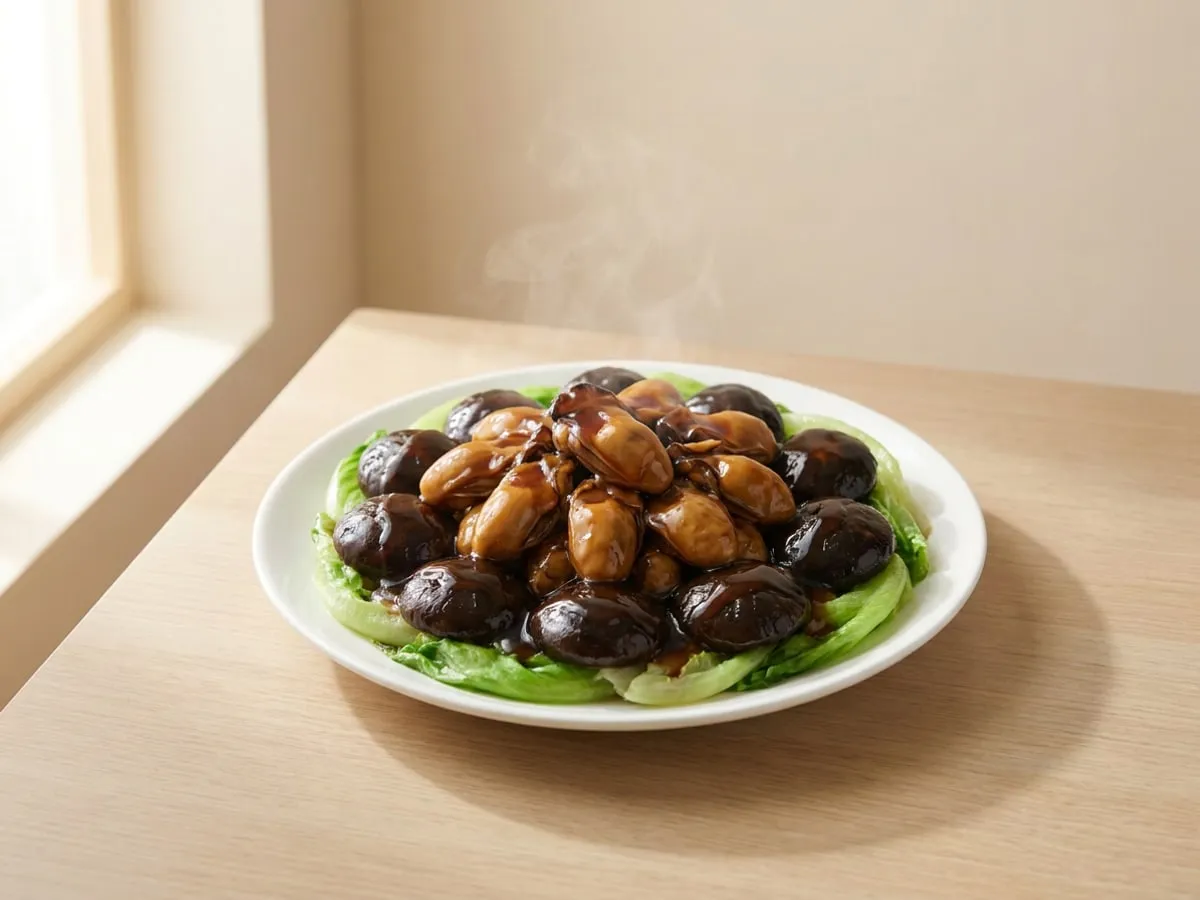
Dried oysters braised with shiitake, the 好市 dish
“You eat after the offering. These few dishes are what the year waits for.”
Ingredientsserves 6
Equipment
- A heavy lidded pot or a deep wok. Nothing else.
How the time splits
- 4 hrThe mushrooms soakhands off
- 10 minRinse the oysters, trim the mushrooms, fry the gingerhands on
- 30 minLid on, low heathands off
- 15 minLid off to reduce — you cannot walk awayhands on
Method
- Rinse the mushrooms and soak them in cold water for four hours, or overnight in the fridge. Strain and keep the soaking water, and cut off the stems.
- Rinse the dried oysters twice under clean water, rubbing the grit off with your fingers and opening out the frilled edge to check inside. Rinse, do not soak: soaked oysters leave their flavour in the water you tip away. Some families do soak them for ten minutes; if you do, strain that water and put it in the pot too.
- Heat the oil and fry the ginger, add the oysters and mushrooms and turn them through, splash in the wine, add the soy, sugar and oyster sauce, and pour in mushroom water just to cover.
- Bring it to the boil, cover and braise on low for thirty minutes. The oysters need all thirty to soften; take them off early and they are tough.
- Uncover, turn the heat to medium and reduce for about fifteen minutes, until the sauce is thick enough to coat the oysters. Do not leave it: there is sugar and oyster sauce in there, and the moment it runs dry it catches, and the burnt taste goes into the oysters for good. Taste at the end. The dried oysters are the seasoning, and if this batch is mild, add another teaspoon of oyster sauce.
- Blanch the lettuce for the bed, put the oysters in the middle and the mushrooms round the edge, and pour the sauce over.
Take care
- Mollusc (dried oysters and oyster sauce), soy, wheat. Braise the oysters right through, and do not use any that smell rancid.
The story
蠔豉, dried oysters, sounds like 好市, good business. In many families it is the first dish eaten on the first day of the year, the 開年 dish, so the year starts with trade. It used to be 髮菜蠔豉, 發財好市, fortune and good business; this site does not use 髮菜 — wild harvesting has been banned at source since 2000, and most of what is sold is imitation — so the dish loses the 發財 half of its wish and keeps everything else. 燜冬菇 is its plainer sibling, where the mushrooms are the dish; here the oysters are the dish and the mushrooms keep them company. A line like rinse the oysters, never soak them, is the sort of thing no recipe writes down; it was learnt standing next to Ah Ma at the stove.
Same kind
Lo Fo Tong is cultural food-heritage reference, not medical advice. If you are pregnant, unwell or on medication, talk to your doctor or registered practitioner before changing what is in the pot.