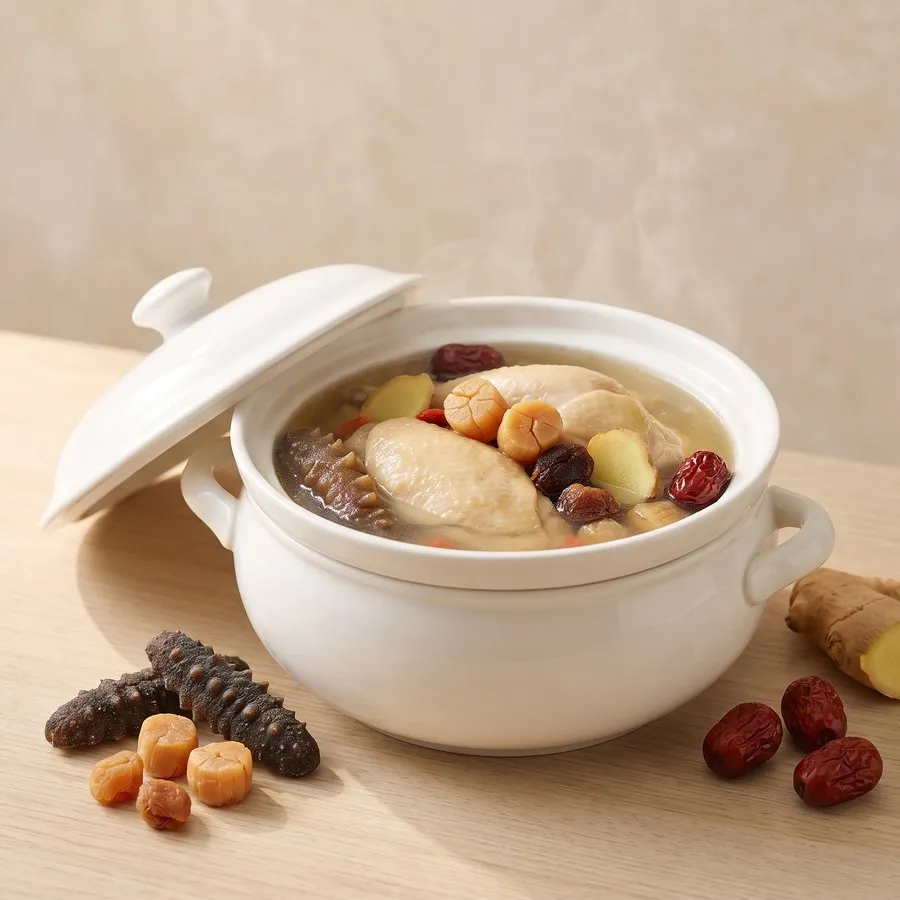
Sea cucumber (dried)
The dried body wall of the sea cucumber, a marine animal sold as hard, dark whole pieces that need two to five days of careful soaking and simmering to rehydrate. Once reconstituted it is gelatinous and springy with almost no flavour of its own, absorbing the taste of the soup while adding a rich, slippery body. It is usually added near the end of cooking so it does not dissolve.
TCM properties
Nature · neutral Flavour · sweet、salty Meridians · kidney
Traditional food therapy
In Cantonese food therapy it is used to fortify the kidneys, replenish blood and essence, and moisten dryness; it is also traditionally valued as a high-protein, low-fat tonic food.
Cautions: read first
- Not suitable while you have a cold or diarrhoea
- Check with your doctor if you take anticoagulant medication (its mucopolysaccharides have an anticoagulant action)
- Avoid if you are allergic to seafood
Preparation
Rehydrating takes 2 to 5 days, changing the water daily and keeping it away from oil and salt. For soup use sea cucumber that is already rehydrated, and add it towards the end of the boil.
Origin · Geo-authentic (道地) source
Dalian in Liaoning (liu shen, the spiky sea cucumber, is the most celebrated); Australian ju po sam (豬婆參) is also a traditional source. Australian retail spans grocer grades to premium spiky and Iceland wild lines; Australia also produces its own (ju po sam)
Availability in Australia
Herbal shops / specialists