All Sunday dishes › The festival table
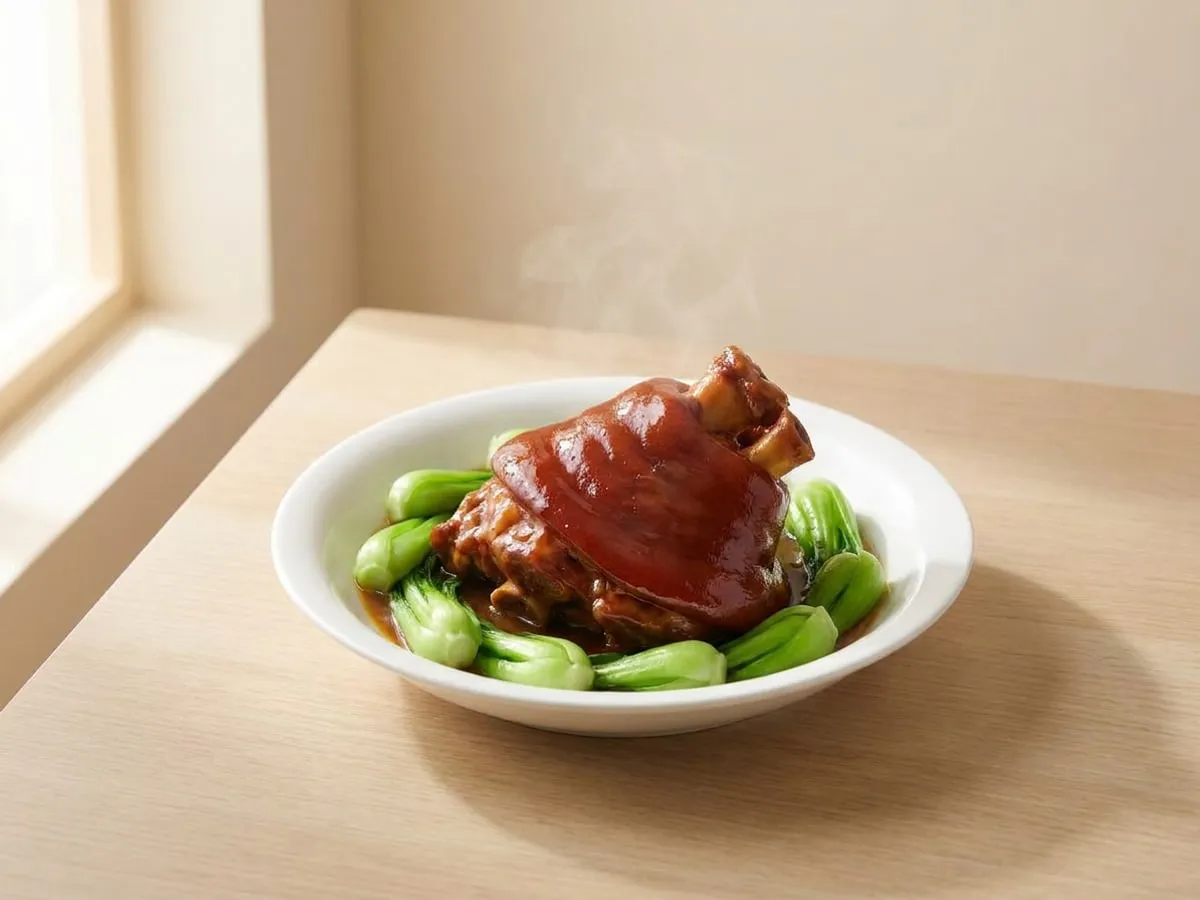
Red-braised whole pork hock
Also called Red-braised pork hock
“You eat after the offering. These few dishes are what the year waits for.”
Ingredientsserves 6
Equipment
- A deep pot the hock just fits, no bigger: the liquid has to come three-quarters of the way up
- A wok and its lid: wet skin spits in hot oil
- Tongs, and two wide spatulas for turning and lifting it
- Tweezers or a kitchen blowtorch for stray hairs, and a fan or a hairdryer on cool for the skin
How the time splits
- 15 minClean off any hair, blanch, rinse in cold waterhands on
- 15 minDark soy on the skin, dried in front of a fanhands off
- 15 minBrown the skin, with the wok lid as a shieldhands on
- 5 minMelt the rock sugar and make the braising liquidhands on
- 2 hr 30 minLid on at a bare simmer, turned gently every half hourhands off
- 15 minBlanch the greens, reduce and thicken the saucehands on
Method
- Check the skin for stray hair and pull it out with tweezers or burn it off with a blowtorch; trim the hoof clean and wash the whole hock.
- Put the hock in a big pot, cover it with cold water, add three slices of ginger, two spring onions and a tablespoon of wine, bring it to the boil and boil ten minutes more, skimming off the scum. Rinse it under cold water and pat it dry.
- Brush the skin all over with dark soy and dry it in front of a fan for about fifteen minutes. Dry skin colours evenly and spits less in the oil.
- Heat three tablespoons of oil in the wok over medium heat, put the hock in and get the lid over it at once, then turn it side by side until the skin is a deep reddish gold and tight all over, spooning hot oil over the parts that do not touch the wok, about ten to fifteen minutes. Lift it out.
- Pour off most of the oil, leaving about a tablespoon, and melt the rock sugar over low heat until it is pale gold. Add the rest of the ginger, the garlic and the spring onion whites and fry until fragrant, splash in the half cup of wine, then add the light and dark soy and six cups (1.5 litres) of water and bring it to the boil.
- Put the hock into a deep pot it just fits, pour the boiling liquid over to come three-quarters of the way up, and add the star anise, cassia and Sichuan pepper. Bring it back to the boil, cover, and keep it at a bare simmer on the lowest heat for two and a half hours, turning it gently every half hour with a spatula underneath so the top colours too. It is done when a chopstick slides into the thickest part with no push and the bone moves when you wiggle it; if not, give it longer. Do not lift it at an hour: chopped trotter is ready by then, but a whole hock is not, and the skin stays rubbery and the meat clings to the bone.
- Blanch the 菜心 and drain it. Slide two wide spatulas under the hock and move it whole onto a deep plate, skin up, uncut.
- Skim the fat off the sauce, boil it down by about half over high heat, thicken it lightly with the cornflour slurry and add a few drops of sesame oil. Pour it over the hock and ring the plate with the 菜心. It goes to the table whole, and the meat is pulled off the bone with chopsticks at the table.
Take care
- Pork, soy, wheat, sesame, alcohol (Shaoxing wine, mostly cooked off over the long braise). The meat beside the bone must be cooked through to 75 °C. Wet skin spits in hot oil: dry it first and shield it with the lid.
- A whole hock in its sauce cools slowly: take leftover meat off the bone or cut it up, divide it into small containers and refrigerate within two hours, then reheat it right through.
The story
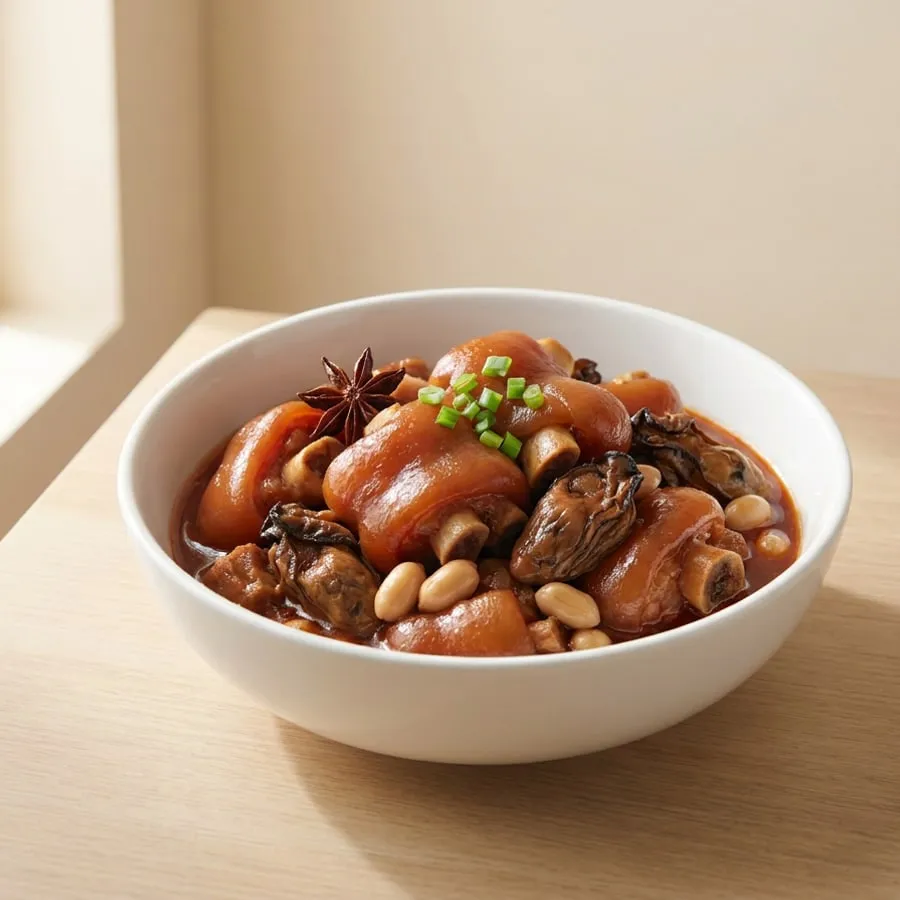
元蹄 is a Shanghainese New Year dish: a whole front hock, red-braised in one piece and brought to the table whole, for a family gathered complete. It is not the site's 南乳炆豬手. That one is trotter chopped through the bone into pieces of about 5 cm, coloured and seasoned with fermented red bean curd and braised with peanuts and mushrooms for an hour or so. 元蹄 is never cut: its colour comes from dark soy and caramelised rock sugar, it braises with star anise and cassia for more than two hours, and it is only shared out at the table. 迷你, mini, is the household size, a little over a kilo, small enough for an ordinary pot.
Same kind
Lo Fo Tong is cultural food-heritage reference, not medical advice. If you are pregnant, unwell or on medication, talk to your doctor or registered practitioner before changing what is in the pot.